FastText:高效的文本分类工具
随着大数据时代的到来,文本分类成为了自然语言处理领域中最重要的任务之一。文本分类可以帮助我们自动将大量文本分为不同的类别,从而加快信息的处理和理解。FastText是Facebook AI Research团队开发的一个高效的文本分类工具,它能够在处理大规模文本数据时快速训练模型。在本篇博客中,我们将介绍FastText模型的原理、优缺点以及如何使用FastText模型来进行文本分类任务。
1. FastText模型原理
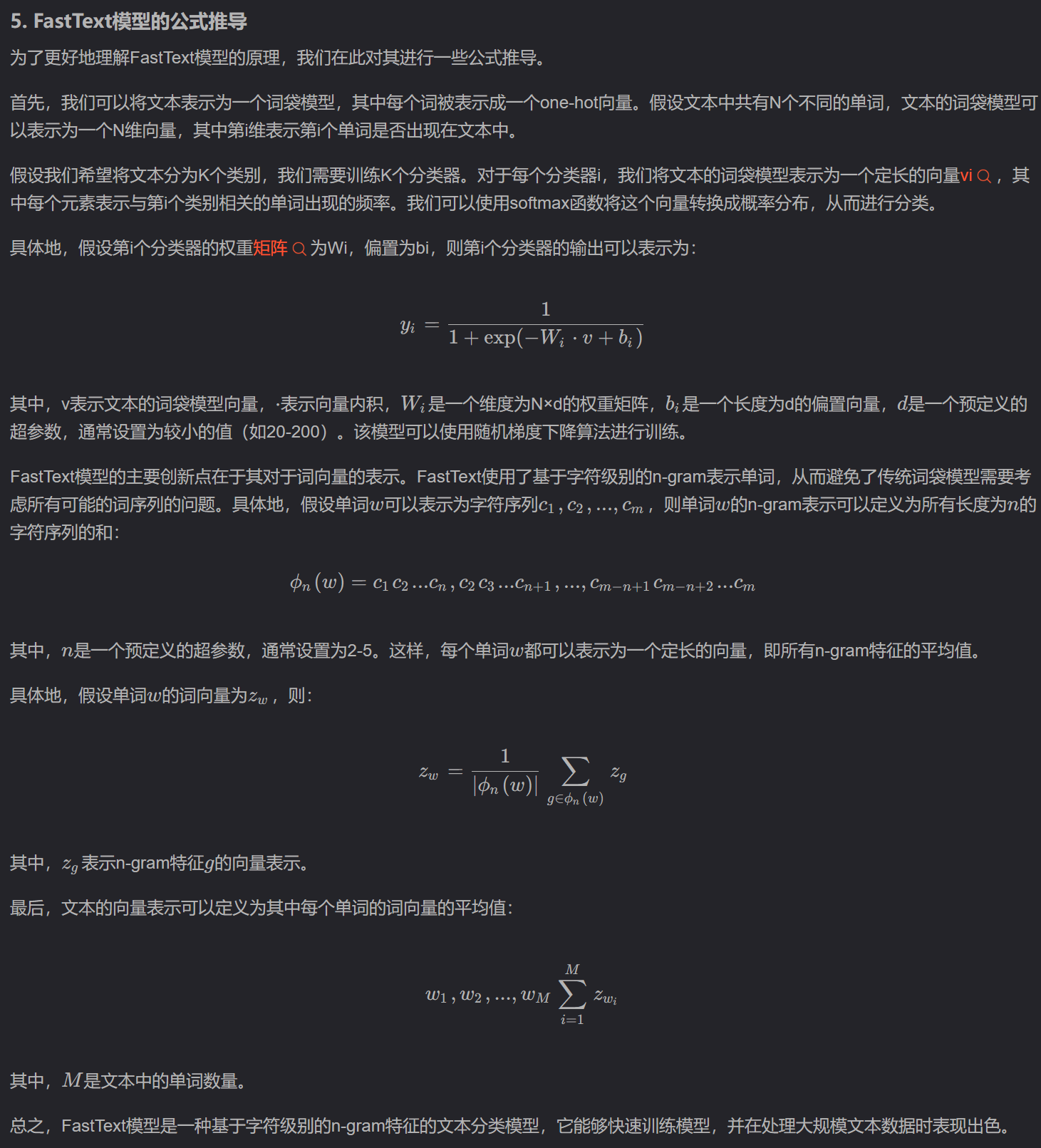
FastText模型是基于词向量的文本分类模型。它采用了基于字符级别的n-gram特征表示文本中的词,从而避免了传统的词袋模型需要考虑所有可能的词序列的问题。FastText的训练过程中,每个词会被表示成一个定长的向量,然后将这些向量组合成文本的向量表示,最后使用softmax函数进行分类。
FastText的主要优势是其高效性。它使用了层级softmax(hierarchical softmax)来加速训练过程。层级softmax是一种用于处理大规模分类问题的方法。它将标签树化,使得每个标签只需要与其父节点的分类器进行计算,而不是对所有可能的标签进行计算。这种方法能够大大减少计算量,从而提高了训练速度。
除了层级softmax,FastText还使用了负采样(negative sampling)来训练模型。负采样是一种用于优化词向量训练的技术。它通过从未出现在当前上下文中的单词中随机采样一定数量的单词,将它们作为负样本与当前上下文中的单词进行比较。负采样可以使得模型更加鲁棒,同时也可以提高训练速度。
FastText模型的缺点是其对于长文本的处理能力相对较弱。由于FastText采用的是基于词向量的方法,它很难对于超出单词级别的信息进行建模。此外,由于FastText使用的是n-gram方法,对于较长的文本,它需要建模的特征数量较多,这也会导致训练过程的复杂度增加。
2. FastText模型的优缺点
FastText模型具有以下优点:
- 高效性:FastText采用了层级softmax和负采样技术来加速训练过程,从而能够处理大规模文本数据。
- 鲁棒性:FastText使用n-gram特征表示文本,能够捕捉到单词之间的关系,使得模型更加鲁棒。
- 高度可扩展:FastText模型能够轻松地适应新的类别或文本类型。
FastText模型的缺点包括:
- 对于超出单词级别的信息建模能力相对较弱。
- 对于较长的文本,模型需要建模的特征数量较多,训练过程的复杂度增加。
3. FastText模型案例
下面我们将介绍如何使用FastText模型来进行文本分类任务。我们将使用IMDb电影评论数据集进行实验。
(1)数据准备
下载
IMDb数据集:https://ai.stanford.edu/~amaas/data/sentiment/
我们首先需要将数据集分为训练集和测试集。我们将70%的数据作为训练集,30%的数据作为测试集。
|
1 2 3 4 5 6 7 8 9 10 11 12 13 14 15 16 17 18 19 20 21 |
import pandas as pd import numpy as np # 加载数据集 def load_data(file_path): data = pd.read_csv(file_path, header=None, delimiter="\t", names=['label', 'text']) data['label'] = np.where(data['label'] > 5, 1, 0) # 将评分大于5的评论视为正向评论 return data # 划分训练集和测试集 def split_data(data, split_ratio=0.7): train_size = int(len(data) * split_ratio) train_data = data[:train_size] test_data = data[train_size:] return train_data, test_data # 加载数据集 data = load_data('imdb.tsv') # 划分训练集和测试集 train_data, test_data = split_data(data, 0.7) |
接下来,我们需要对文本进行预处理。首先,我们将文本转换成小写,并去除标点符号和数字。然后,我们将文本分词,并去除停用词(如“the”、“a”、“an”等常用词语)。最后,我们将文本转换成n-gram特征表示。
|
1 2 3 4 5 6 7 8 9 10 11 12 13 14 15 16 17 18 19 20 21 22 23 24 25 26 27 28 29 |
import re import string import nltk from nltk.corpus import stopwords from sklearn.feature_extraction.text import CountVectorizer # 预处理文本 def preprocess_text(text): # 将文本转换成小写 text = text.lower() # 去除标点符号和数字 text = re.sub('[%s]' % re.escape(string.punctuation + string.digits), '', text) # 分词 tokens = nltk.word_tokenize(text) # 去除停用词 stop_words = set(stopwords.words('english')) tokens = [token for token in tokens if token not in stop_words] # 提取n-gram特征表示 vectorizer = CountVectorizer(analyzer='char', ngram_range=(1,3)) features = vectorizer.fit_transform(tokens) return features # 对训练集和测试集进行预处理 train_features = [preprocess_text(text) for text in train_data['text']] test_features = [preprocess_text(text) for text in test_data['text']] |
(2)训练模型
接下来,我们使用FastText模型来训练文本分类模型。我们使用默认参数进行训练。
|
1 2 3 4 |
import fasttext # 训练模型 model = fasttext.train_supervised(input=train_features, label=train_data['label']) |
(3)使用模型进行预测
训练完成后,我们可以使用训练好的模型对测试集进行预测,并计算模型的准确率、精确率、召回率和F1值。
|
1 2 3 4 5 6 7 8 9 10 11 12 13 14 15 16 |
# 对测试集进行预测 predicted_labels = model.predict(test_features)[0] predicted_labels = [int(label[0]) for label in predicted_labels] # 计算准确率、精确率、召回率和F1值 from sklearn.metrics import accuracy_score, precision_score, recall_score, f1_score accuracy = accuracy_score(test_data['label'], predicted_labels) precision = precision_score(test_data['label'], predicted_labels) recall = recall_score(test_data['label'], predicted_labels) f1 = f1_score(test_data['label'], predicted_labels) print('Accuracy: {:.4f}'.format(accuracy)) print('Precision: {:.4f}'.format(precision)) print('Recall: {:.4f}'.format(recall)) print('F1: {:.4f}'.format(f1)) |
4. 结论
FastText是一种高效的文本分类模型,它使用n-gram特征表示文本,并采用层级softmax和负采样技术来加速训练过程。FastText模型的优点包括高效性、鲁棒性和高度可扩展性,但其缺点包括对于超出单词级别的信息建模能力相对较弱,以及对于较长的文本,训练过程的复杂度增加。在实际应用中,我们可以根据具体任务的需要选择不同的文本分类模型来进行训练。
from:https://blog.csdn.net/qq_41667743/article/details/129629136